








Christianity is exerting a growing presence in China not only through proliferating churches but also due to their architectural style and geography, writes Michel Chambon in the journal Studies in World Christianity (July/August). The anthropologist studied the locations and architectural styles of congregations in the city of Nanping and the province of Fujian, an area […]
The International Yearbook of Religious Demography (Brill, $98) has quickly emerged as the equivalent to an annual journal on religion and demography. With its global reach and plethora of useful statistics, the 2017 yearbook, edited Brian Grim, Todd Johnson, Vegard Skirbekk, and Gina A. Zurlo, yields important insights on issues ranging from the familiar ground […]
Father James Mallon has gained prominence among Catholics for his synthesis of evangelical and Catholic practices while growing his parish in Canada, and now he is taking his teachings on the road with the formation of the Divine Renovation Network. Based on his widely popular book Divine Renovation, the network will work with churches in […]
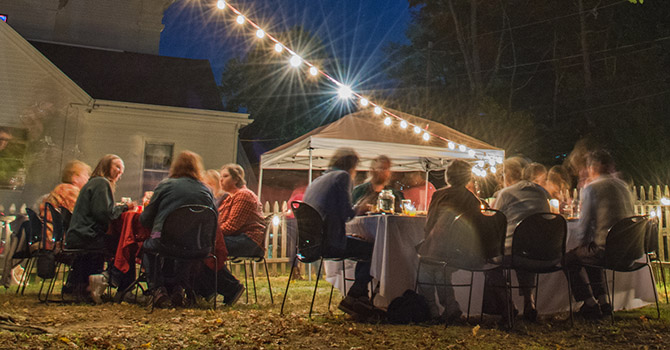
Mainline and evangelical Protestants, both in the U.S. and abroad, are responding to the challenges of decline, institutionalism, and political conflict by creating new structures often based around intimate community and sharing a meal. Mainline churches have long experimented with alternative forms of ministry to stem their dramatic declines in members, but one such alternative showing increasing popularity are dinner and “café” churches that take an entrepreneurial approach to supporting their ministries. The Faith and Leadership blog (June 13) reports that United Methodist congregations have formed a new network, known as Simple Church, whose services are based around shared meals with communion included, as well as conversation replacing the sermon. The idea of a supper-based church is not exactly new, but it has caught on in mainline circles starting with New York’s St. Lydia’s Kitchen, a Lutheran-Episcopal church plant in the early 2000s. The original Simple Church is a United Methodist congregation in North Grafton, Massachusetts, that is what is often called a “re-plant”—a struggling congregation reorganized by the denomination. More uniquely, the church pioneered a revenue model that “puts less strain on parishioners by generating income from a trade—in this case, bread baking.”
The Simple Church format has spread to other states and Canada, with 11 affiliate congregations practicing table-centered worship, often relying on trade-based enterprises for revenue. The Simple Church in North Grafton, which has grown from zero to 70 members in three years, is planting its first daughter congregation nearby in central Massachusetts later this year. While Simple Church’s “folksy hymns and simple prayers” hark back to traditional Methodism, it does not have any statement of faith and is similar to other dinner churches that are at the progressive end of the spectrum. It stresses inclusivity, which involves inviting all participants—often Christian and non-Christian—to take communion as well as accepting the LGBTQ community. The article reports that several of the participants also attend conventional services on Sunday morning. Unlike the mainline alternative churches that seek renewal and growth in declining denominations, evangelical alternative congregations often are reacting against the influence of megachurches and evangelical conservative political involvement— a sentiment that has driven much of the “emerging” church movement in North America, Europe, and Australia.
American Indians have long had the attention of missionaries and evangelists, but more recently they have become the protagonists of numerous prophecies by charismatic Christians that the First Nation tribes and their reservations are the harbingers of revival in America, according to Charisma magazine (June). In 1975, Billy Graham prophesied that Native Americans hold the […]
Even though it has been considered a conservative religious rallying cry, a Public Religion Research Institute survey finds that 61 percent of Americans oppose allowing businesses to deny services to gays and lesbians. The issue became headline news when the Supreme Court considered taking the case of a Colorado baker who refuses on religious grounds […]
Not unlike other Western countries, Finland has seen a decline of membership in mainline denominations along with a growth of unaffiliated people and religious diversification, Tuomas Martikainen (Migration Institute of Finland) reported at a conference on the religious and ethnic future of Europe in Turku on June 12–13, which RW attended. For historical reasons there […]
Japan’s rapidly dropping birth rate, relatively high abortion rate, and low adoption rate have generated a small but growing pro-life movement in the country, receiving more support from evangelical Protestants rather than Catholics, writes Jason Morgan in the social science journal Society (June/July). Japan’s government has encouraged couples to have more children as the birth […]
As new Buddhist movements and groups, many from other Asian countries, spread throughout China, they are facing changes to their teachings and practices, even as they exert considerable change in Chinese society, according to a report in the New York Times (June 25). The newspaper focuses on the Taiwanese-based group Fo Guang Shan, which arrived […]
ISR co-director Byron Johnson, William H. Wubbenhorst, and Alfreda Alvarez recently issued Assessing the Faith-Based Response to Homelessness in America. The 146-page report is based on an initial 11-city study on faith-based organization’s (FBO) impact on homelessness, measuring the percentage of emergency shelter beds provided by these ministries. The report also includes a 3-year projection […]