







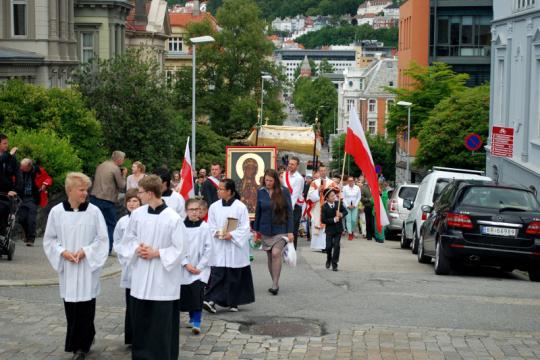
Secularization, immigration, conversions, and a young generation’s hunger for spiritual meaning are transforming the religious landscape of Norway and making a new place for Roman Catholicism in that country, reports Pierre Jova in the French Catholic weekly La Vie (December 10). While Catholicism remains a minority faith in this traditionally Lutheran nation of 5.5 million, its growth has been striking. Registered Catholics have risen from approximately 46,000 in 2009 to 168,000 in 2025, representing about 3 percent of the population. Actual numbers may be considerably higher—between 250,000 and 300,000—since many immigrants never formally register with the church. This could make Catholicism Norway’s second-largest religion, after the Lutheran Church (which claims 62 percent of the population) and ahead of Islam (3.5 percent). Immigration has been the major channel for the growth of Catholicism in Norway. Besides that, some practicing Lutherans have been attracted to Catholicism due to its doctrinal stability, liturgy, and historical tradition, writes Jova. Among recent converts to Catholicism are also young men aged 15–35, many without a religious background, who often discovered Catholicism through conservative North American voices on YouTube, including psychologist Jordan Peterson and Bishop Robert Barron.
The established Lutheran Church of Norway, while no longer representing the state religion since 2012, has struggled with its historical ties to government. Professor Bernt Oftestad, a church historian who converted to Catholicism in 2000, describes the Lutheran Church’s “curse” as its “allegiance to the state, which reduced it to being the nation’s social worker, without spiritual content.” The church’s 2016 decision to celebrate same-sex marriages has not stemmed its decline. A 2020 survey found that 48 percent of Norwegians did not believe in God, while only 30 percent affirmed belief. Despite lively Lutheran pockets, as well as the remnants of evangelical and Lutheran pietism in the country’s southwestern Bible belt, “there is hardly anything left to secularize in Norway,” said Erik Varden, Catholic Bishop of Trondheim, who became the first native Norwegian bishop since the Reformation when appointed in 2019. He sees opportunity in Norway’s thorough secularization, however. “This is an enormous cultural and religious loss, but it gives us an immense possibility to proclaim the Gospel for the first time, since our populations have forgotten what it is about,” he remarked.