







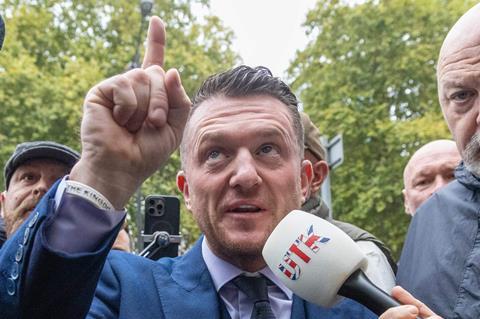
Growing interest in Christianity in the UK, with some (disputed) indications of growing church attendance and involvement, is being tied to far-right activism in the country, according to reports. The Church Times (November 26) reports that church leaders are cautioning their members not to let their faiths be converted into political extremism. At a recent conference, Pentecostal Bishop Mike Royal warned his listeners about not letting the “quiet revival” be stolen by “Christian nationalism,” even though he acknowledged that there was a middle ground where national pride was commendable. The “quiet revival” refers to the phenomenon of increased church attendance in the UK—though these reports of church growth have been questioned—particularly among young people. The warning of Royal and other church leaders came in the wake of the evangelical conversion of far-right leader Tommy Robinson in prison, and the news that his supporters are likewise turning to Christianity. A man who started attending church and who also frequented Robinson’s rallies said, “I never thought I had to choose before, but now I’m feeling like Christianity could be replaced; so that’s why I feel the Church needs support.” He spoke of the church as being threatened by Islam, citing its extremist elements rather than the religion as a whole.
The Guardian newspaper (November 25) reports that the relationship between the far right and Christianity moves mainly in one direction, as political leaders have expressed interest in strengthening a Christian identity for Britain. Earlier this year, Conservative MP Danny Kruger spoke in parliament about the need for the restoration of Britain through the “recovery of a Christian politics.” Kruger then joined the Reform party, whose leader Nigel Farage now invokes the need to return to “Judeo-Christian” values. Lamorna Ash reports that the “unite the kingdom” march that Tommy Robinson led showed an abundance of Christian symbolism, with pastors on stage giving speeches and leading worship songs. Ash adds that Robinson’s faith “mirrors an important development that is taking place among European far-right groups, which are shifting the emphasis of their political messaging from ethnicity to religion.” If a religious right has been exported to Britain from the U.S., which is not clear from this article, it seems more often concerned about religious freedom than establishing a Christian state. Ash points to the cases of Christians in the UK brought to court for illegally praying in abortion clinic “buffer zones,” to protect clients and workers.
The U.S.-based legal advocacy group Alliance Defending Freedom more than doubled its spending in the UK and has started a branch there. Meanwhile, the charismatic Anglican network based around the influential Holy Trinity Church, Brompton (HTB), which launched the Alpha program, is reported to be “caught up in this rising Christian nationalism,” according to the Substack newsletter Ecstatic Integration (October 17). Editor Jules Evans reports that “some figures in the HTB network have helped drive [Christian nationalism] (while others see it as a big mistake).” A key figure is billionaire Sir Paul Marshall, who is on HTB’s revitalization trust and whose Sequoia Trust has given tens of millions to HTB causes. Marshall co-owns GB News, a British version of Fox or Breitbart, which in August overtook the BBC to become the most-watched UK news channel. Marshall was the UK’s biggest philanthropist in 2024, giving away £145 million, or 17 percent of his wealth, in one year. He funded the Alliance for Responsible Citizenship (ARC) conference earlier this year, hosted by Jordan Peterson and organized by HTB Christian Philippa Stroud. ARC is said to be the largest conservative conference in the UK, according to Evans.