








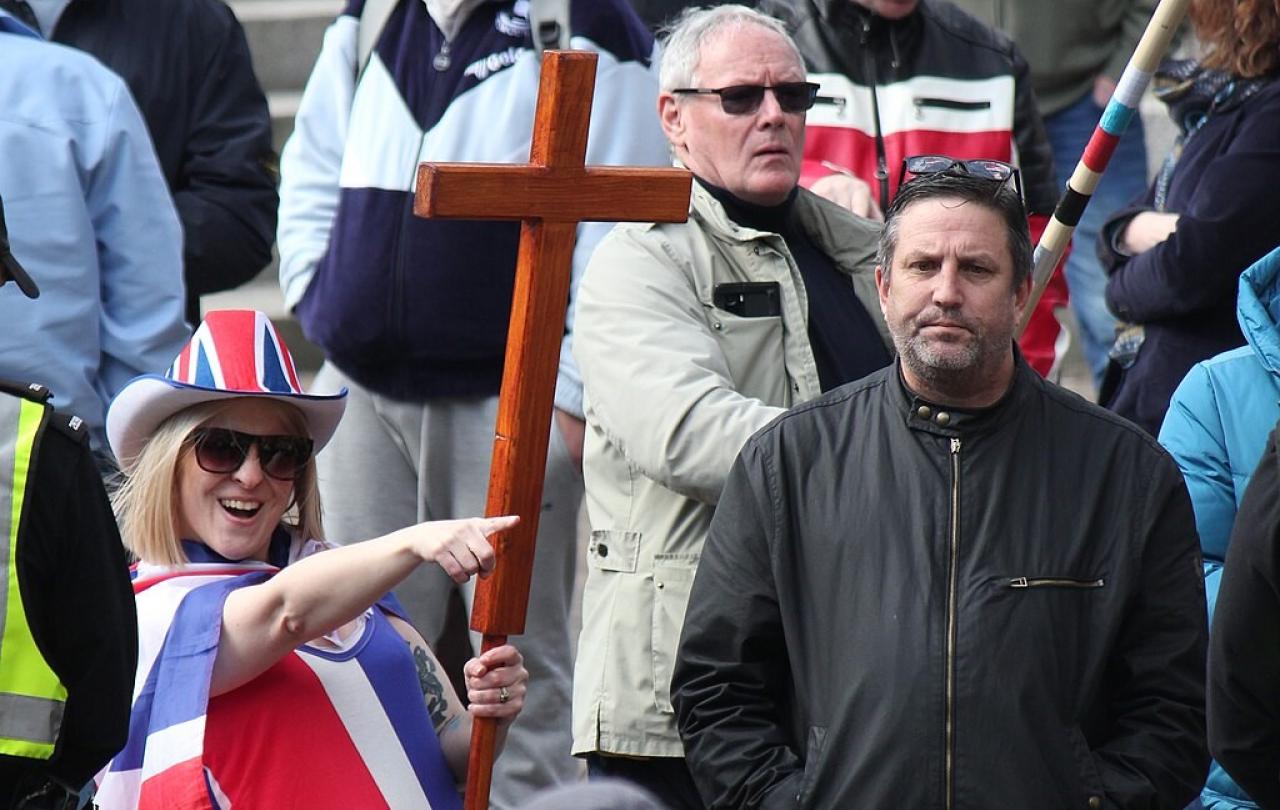
While the conflict between religious conservatives and liberals has long characterized the “two party” system in American religion, scholars are now observing a new divide between pluralists and anti-pluralists. This was evident in Johns Hopkins University sociologist Ruth Braunstein’s presidential address given at the early-November meeting of the Society for the Scientific Study of Religion in Minneapolis, which RW attended. Braunstein said that Robert Wuthnow’s 1988 book, The Restructuring of American Religion, developed the idea that from the 1950s to the 1990s, faith groups were divided by their adherence to liberal and conservative theology and politics, often expressed through their denominational affiliations. But she added that since then, with the sharp growth of religious non-affiliation, “a new restructuring is taking place, [with] a shift from denominations to political tribes.” The shift can be most clearly seen among American evangelicals “who are sorting themselves into those who support Christian nationalism. And this sorting is also taking place in the larger society.” This sorting can also be seen in reports from pastors that people are shopping for Christian nationalist churches. Braunstein argues that these anti-pluralist Christians “support a monoculture” and are “pursuing an authoritarian ethno-state,” where “white Christian nationalists” will hold sway.
At the same time, evangelicals and other religious conservatives who feel they are without a political home during the Trump administration and who are more accepting of a pluralist America are joining ranks with the religious left, interfaith groups, and “purple” or non-political mainline Protestants in such organizations as the American Values Coalition and the After Party. These groups often use the language of pluralism as the line dividing them from the religious right. Braunstein sees “side-switching” taking place, with such evangelical leaders as Russell Moore of Christianity Today magazine and columnist David French embracing the pluralist party, while many Latino evangelicals are moving in the other direction, as seen in their strong support for Donald Trump. While Braunstein’s theory is closely tied to America’s culture wars and is focused on evangelicals, the split between pluralists and anti-pluralists is also taking place on a global scale and is likely to have an impact on religious freedom, according to political scientist Robert Joustra. Writing for the blog of the Institute for Global Engagement (November 6), Joustra writes that the “major powers in international relations are all, to one degree or another, rediscovering different forms of national identity or what could be, if ambiguously, called nationalism.” Joustra writes that such changing geopolitical conditions go beyond the old framework of religious and secular competition to involve pluralist/anti-pluralist competition.
He adds that this framework “shifts or at least augments the current religious vs. secular debates about state pluralism to a somewhat more pragmatic approach.” In other words, the new debate will be about how anti-pluralists deal with religious and other kinds of differences within their societies. Joustra argues that “there are two main anti-pluralist challengers today: progressive anti-pluralism, and nationalist anti-pluralism. While these approaches seem opposite to many on the Western political spectrum, they both in fact support the use of political power to inject a form of anti-pluralism into the political sphere. I argue that they could, therefore, be considered more alike than they are different. They further have a kind of symbiotic horseshoe relationship: fear of the other anti-pluralism tends to drive more extreme versions of their own anti-pluralist tendencies. Further, I argue that emerging geopolitical shifts in the world suggest that progressive anti-pluralism is generally on the decline, whereas nationalist anti-pluralism is ascending.”