







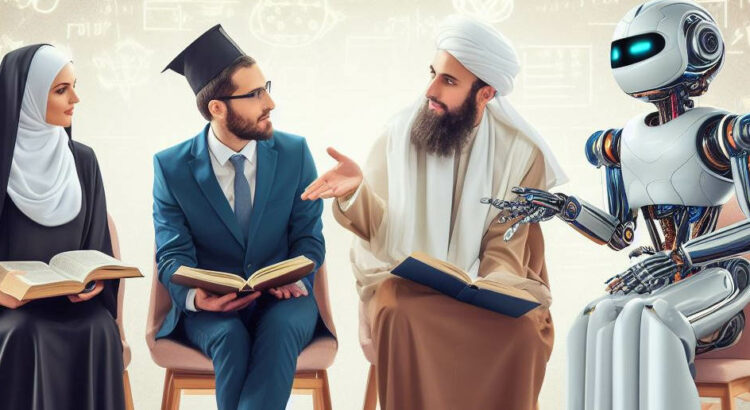
Religious AI is bringing about both a doctrinal mutation and cognitive mutation—substituting an algorithmic process for human mediation and modifying how believers perceive and construct spiritual meaning. So writes French political scientist François Mabille of the Geopolitical Observatory of Religion, in a Note of the Observatory (November). Through spiritual chatbots, AI is establishing itself as a new intermediary between humanity and the sacred. The history of religions has always been linked to technical mediations (such as the scroll, codex, printing press, internet). But Mabille argues that AI represents a qualitative rupture, since it no longer merely transmits the sacred message but co-produces it, moving from a logic of transmission to a logic of delegation. Hermeneutical competence, formerly the monopoly of religious experts, is partially transferred to a computational agent. Each religious AI relies on a training corpus that acts as an implicit canon, shaping content by inclusion and exclusion. For instance, the Turkish Diyanet AI reproduces the official discourse of Hanafi Sunnism, acting as an instrument of doctrinal standardization and a tool of government, enabling Turkey to encode its official doctrine and disseminate a state Islam. Each AI model thus functions as a “digital council,” where doctrinal decisions are made in servers rather than synods.
Mabille sees three major pitfalls emerging in this process. The first is dogmatic simplification—the reduction of theological complexity to instant morality. The second is doctrinal rigidification–restricting hermeneutical variability by imposing a single framework, particularly in state-sponsored models. The third is algorithmic heresy—the production of unprecedented interpretations through model generativity, without any awareness of historical or ritual contexts. Spiritual authority does not disappear but shifts, becoming distributed, decentralized, and personalized. The interpreting cleric gives way to the interpreting code. Religious norms become formed by aggregation rather than transmission. “Religious AI does not signal the end of religion but a change of its regime,” Mabille concludes. “Belief is no longer institution and revelation—it becomes interaction and correlation. The divine is no longer merely proclaimed but calculated and distributed. Religious artificial intelligence, far from being a simple technical object, thus becomes an anthropological laboratory of belief.”
(The full article, in French, can be downloaded here: https://www.iris-france.org/lintelligence-artificielle-religieuse-vers-une-mutation-doctrinale-et-cognitive-du-sacre/)