








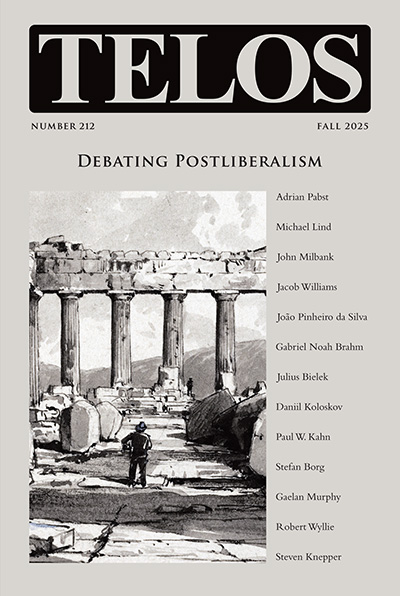
The journal Telos devotes its fall issue to “post-liberalism,” the diffuse movement of conservative scholars and politicians who question the post-Cold War liberal political order and propose often religious and populist alternatives. The issue looks at the way that these movements draw their inspiration from a wide range of religious sources, ranging from Eastern Orthodoxy to Roman Catholicism and Anglo-Catholicism, all the way to Neopaganism. An article by Daniil Koloskov notes how this conservative “revival” is international, even as it is often expressed in nationalist movements that are critical of globalization. This amalgam of views includes everything from the Russian Orthodox philosophy of Alexander Dugin to the pagan philosophy of French “new right” thinkers, Anglo-Catholic thought, and American Catholic integralism (which teaches that Catholicism should be the country’s established religion). Koloskov notes that these thinkers and groups hold to the importance of local traditions and institutions seeking the “common good,” in contrast to big business capitalism and bureaucratic governments that seek to impose order and dominate culture from a distance.
The author provides the example of the Russian Orthodox Church’s community-based initiatives, even as he criticizes the current church for losing a significant number of members under centralization and bureaucracy. Another article by Jacob Williams and Joao Pinheiro da Silva shows how post-liberalism goes beyond illiberal forms of religion, such as Catholic integralism and the anti-liberal populism represented by such thinkers as Patrick Deneen. They focus on the Anglo-Catholic-based post-liberalism known as “radical orthodoxy,” fostered by John Milbank and the Red Tory and Blue Labor factions in UK politics, as well as the post-liberal theology of George Lindbeck and Stanley Hauerwas. These currents all share a strong skepticism of individualism and stress the need for community life and a renewed civic society. Williams and da Silva note that such forms of post-liberalism can be found in both the conservative politics of Philip Blond and Maurice Glasman and the more liberal positions of Milbank.
Another group of post-liberals, or, more accurately, anti-liberals, that the authors identify is the largely American group based around the journals Communio and New Policy, which target liberalism from a conservative Catholic but non-integralist position. Finally, and again more in the anti-liberal camp, are the National Conservatives, led by Israeli philosopher Yoram Hazony, an Orthodox Jew, and many conservative Protestants. This camp doesn’t call for an explicitly confessional politics as much as a broadly based nationalism with a large role for religion and the free market. The articles in this issue don’t give the reader an idea of how many people actually adhere to these various forms of post- and anti-liberalism, nor is there much exploration of how these ideas are embodied in actual institutions and activism, yet they do provide a valuable mapping of the changing landscape of religion and society. For more on this issue, visit: https://www.telospress.com/store/Telos-212-Fall-2025-Debating-Postliberalism-p786508961
The way in which Nordic people are not quite so secular as they are reputed to be, given how they connect ecology to spirituality, is the theme of the current issue of the Journal for the Study of Religion, Nature and Culture (19:3). The editors discuss what they call these “(not quite) secular Northerners” in the context of “ecologizing nature,” which means integrating ecology with cultural dimensions of society, including spirituality. This integration goes against the “differentiation” or separation of these various spheres, and of nature itself, that constitutes modernization. The editors add that the issue seeks to understand the various “quests for nature” that are observed among Northerners. “Why, we asked, have outdoor activities, once again, become so popular all over Scandinavia? How did the forest become an emblem of the Estonian nation? Why did ethnic politics suddenly turn environmental in Norway? And why has rewilding in Denmark ascended within a few years to national politics?” These questions aren’t especially religious or even explicitly spiritual, but the ethnographies on these topics do show “outbursts of the ‘not-quite-secular’ sensibilities captured in words such as ‘almost magical’ or ‘holy,’” touching on cases of animism, “biocene enchantment,” and “weird magic.” For more on this issue, visit: https://journal.equinoxpub.com/JSRNC
The growing movements of Christian Zionism in the global South, particularly Africa, receive in-depth treatment in a special issue of Religion, State, and Society (53:4). These movements are described by the editors as a “charismatic evangelical engagement with, and appropriation of, Jewish histories, rituals, and Zionist political views.” While there have been many studies of Christian Zionism over the years, the articles in this issue are unique in that they examine how the war in Gaza has changed these movements, bringing them into overt political solidarity with Israel. The case of Brazil, probably having the most influential Christian Zionist movement, bears this out: the evangelical caucus, which makes up more than one-quarter of the National Congress, issued a forceful critique of the Brazilian state’s accusation that Israel engaged in genocide during the war.
This pattern of taking sides in a diplomatic and military conflict is seen in other Christian Zionist groups in countries such as Uganda, Congo, and Malawi. Noteworthy articles include a more theoretical study by Paul Freston, who categorizes Christian Zionism into (“ideal-typic”) camps of prosperity, covenantal, cultural, humanitarian, Islamophobic, and indigenous practices and beliefs. An article on Uganda shows how Ugandan elites are at the forefront of efforts to promote these teachings as they translate them into policy, such as promoting economic development, while individual believers equate blessing Israel with achieving God’s blessings on believers. For more on this issue, visit: https://www.tandfonline.com/journals/crss20