- Christian higher education (CHE) is still growing, unlike its broader state and secular counterparts, according to new enrollment data from the 2024 Integrated Postsecondary Education Data System. Writing on a blog for the Gospel Coalition (February 18), Perry Glanzer cites this data as showing that Catholic and Protestant Christian higher education grew by 1.6 percent between the Fall 2023 and Fall 2024 enrollment periods. Protestant institutions’ enrollment alone expanded by 2.4 percent overall during that year. Glanzer adds that “the news gets better for Protestant institutions the farther back one goes. Protestant institutions grew by 3.6 percent over the past five years and by 10.9 percent over the past ten. Given these robust numbers, it is time for Protestants to stop the doomsaying once and for all.” In comparing the CHE figures with those of other sectors of higher education, the data shows state university enrollment is now projected to have declined 3.9 percent during the past decade, and private enrollment is projected to have declined a significant 7.1 percent (the final stats have not yet been calculated for 2024). But even CHE may have to face the fact that years of steady enrollment growth may end soon, as the number of college-eligible students is going to shrink for the foreseeable future. Catholic, Historically Black Colleges and Universities (HBCUs), and mainline Protestant institutions will be the hardest hit, according to Glanzer, as those three sectors have already seen a significant drop in enrollment over the past decade.
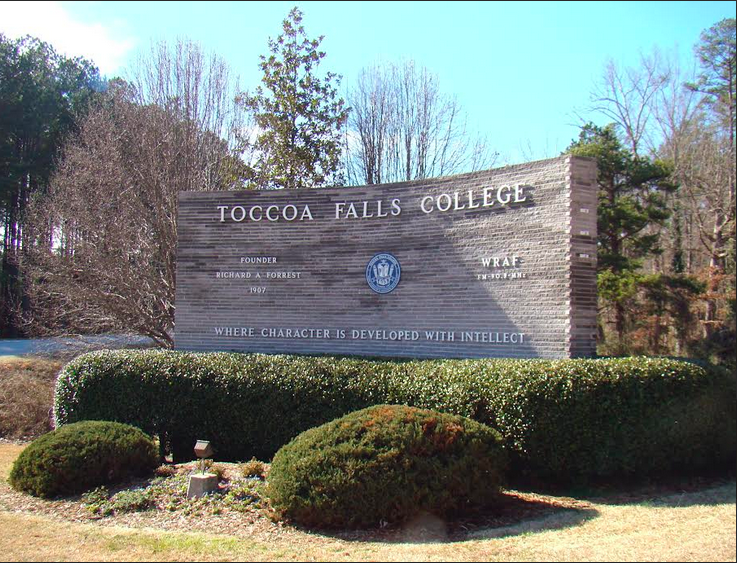
Enrollment “bright spots” for Catholic higher education over the past 10 years have been the University of St. Thomas, MN (245 percent growth), Merrimack College, MA (76 percent), La Roche University, PA (52 percent), and Thomas Aquinas College, CA (50 percent). HBCUs “continue to suffer both in their enrollment numbers and the low commitment they give to the operationalization of any Christian identity.” Simmons College of Kentucky, which has emphasized a Christian identity, has seen a growth of 94 percent. Mainline Protestant universities likewise tend to de-emphasize their Christian mission, while some sell their academic rigor. But Glanzer sees overall mainline decline and/or secularization, with the only two bright spots being Eastern University (with 132 percent growth over the past 10 years) and McMurray University, TX (215 percent growth). That leaves other Protestant schools, represented by the more evangelical International Association of Christian Education (IACE) and Council for Christian Colleges and Universities (CCCU), as the main sources of slow but steady growth and consistent religious identity, led by Toccoa Falls College, GA (233 percent over the past decade), Campbellsville University, KY (216 percent), Southeastern University, FL (200 percent), and Columbia International University, SC (164 percent). Glanzer adds that the closures faced by some CCCU schools such as Trinity International and Trinity Christian (both in IL), are more due to the secularization and depopulation of the Chicago area and the saturation in that market.
(Gospel Coalition, https://www.thegospelcoalition.org/blogs/evangelical-history/are-christian-colleges-doomed/)
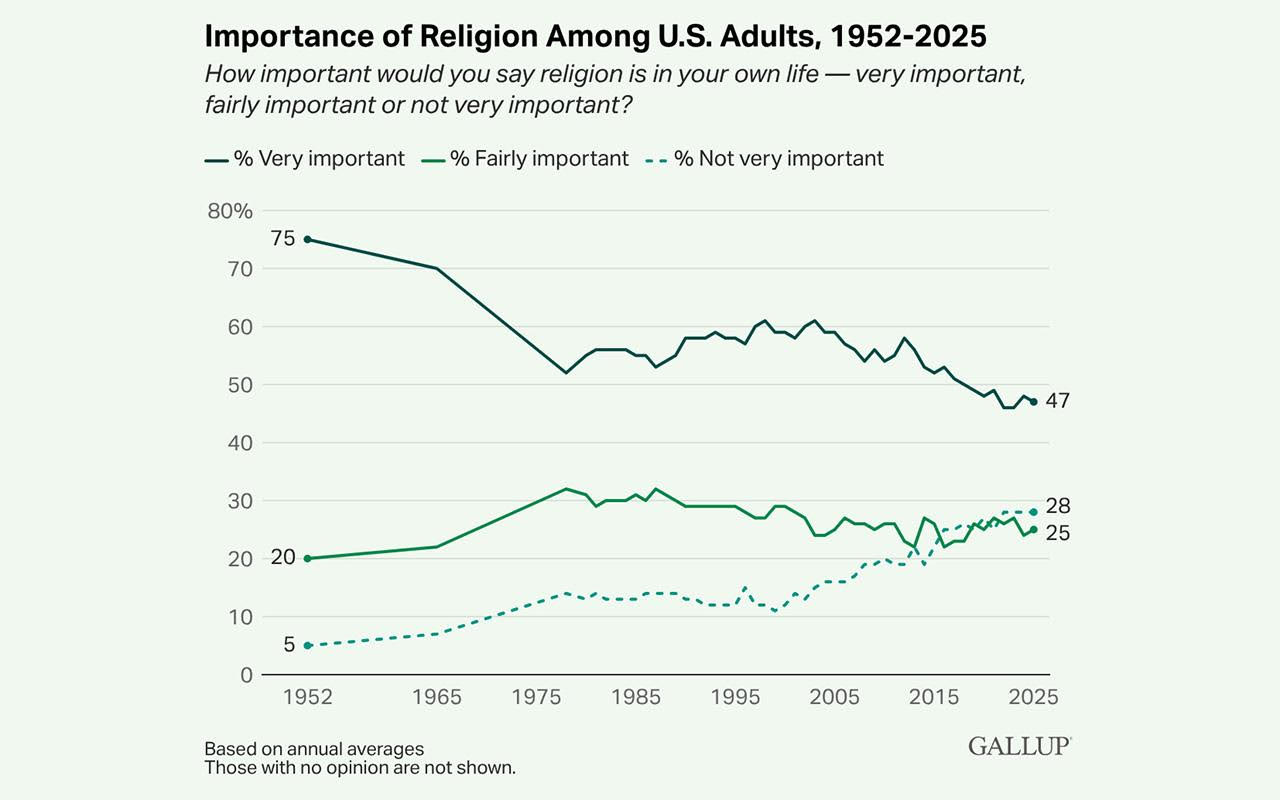
- A new Gallup Poll finds that, while church attendance continues to decline, there has been no significant change in the importance of religion to Americans. The poll found that the percentage of Americans who say religion is “very important” in their lives remained at 47 percent. Religious service attendance continues its gradual decline, according to Gallup. A majority of U.S. residents—57 percent—say they rarely or never attend religious services, compared to 42 percent in 1992. U.S. blacks showed the sharpest decline in saying religion is important. Between 2001 and 2005, 85 percent of U.S. blacks said religion was very important, compared with only 63 percent in 2021–2025. Republicans, holding at 66 percent, were one of the few groups showing no decline in saying religion was very important during the past 20 years. Democrats fell from 60 percent to 37 percent over the past two decades.
- The newly released annual Statistical Yearbook of the Church, which reports on pastoral indicators in world Catholicism, shows significant growth in baptisms and religious vocations in Southeast Asia and West Africa, even if demographic factors have played a big role in such increases. Sociologists Stephen Cranney and Stephen Bullivant, reporting in Church Life Journal (February 3), analyzed the yearbook’s data on baptisms and ordinations over a 50-year period, finding both megatrends and internal variations. For instance, the much-touted explosion of priests from Africa is moderated by the finding that the likelihood that Catholics will pursue ordination has declined in Africa over the past decade. “Interestingly,” they add, “Asian Catholics have the highest ordination rates—a fact that has remained consistent for over four decades. In general, all continents are lower than where they were in the early 1990s. So in large part Africa is becoming the world’s factory for priests simply because it is becoming the world’s factory for people.” Cranney and Bullivant see the Vietnamese church as the most vital on these measures, having moved from about 10 priesthood ordinations per million Catholics in 1993 to nearly 40 today, a fourfold increase.
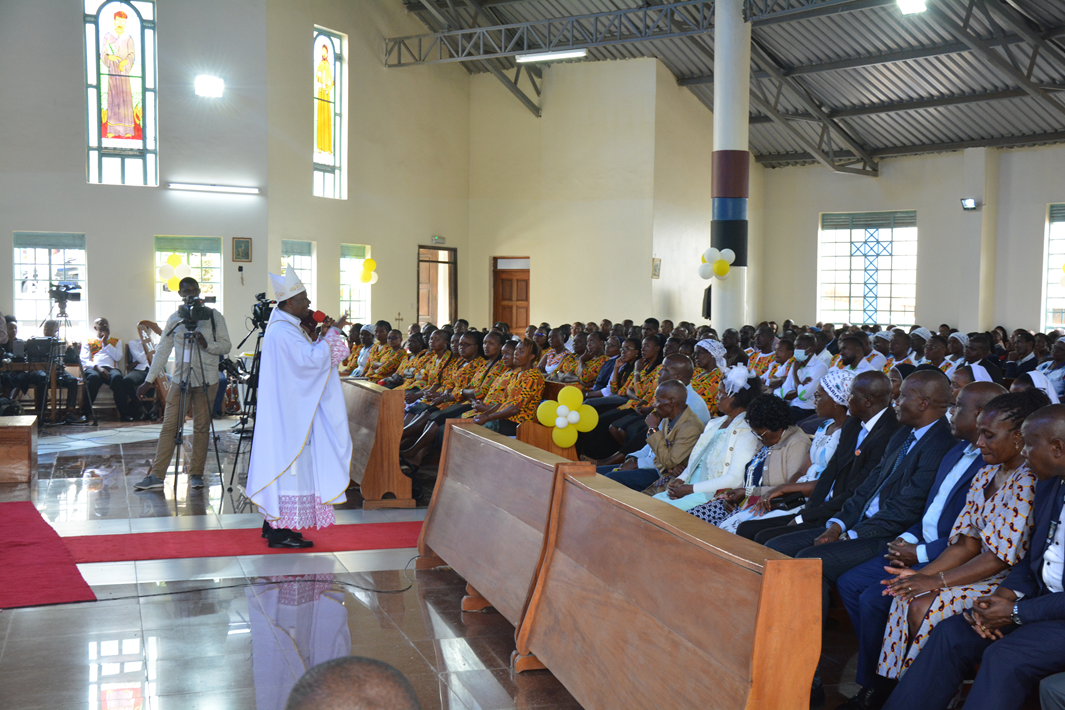
The authors add that baptism numbers generally follow the same trends as priesthood ordinations, with baptisms in Africa having doubled since the 1980s. But as with ordinations, they find a demographic factor behind this trend. By adding population structure into their analysis, Cranney and Bullivant find that the boom in African baptisms is not because of a “day-of-Pentecost-style, conversion-led growth, but more likely because African Catholics—unlike most of the rest of the world—are actually having children in appreciable numbers.” In fact, aside from Africa (and some parts of Asia), every other continent is rapidly trending downward on these measures, most likely due to secularization. The traditional cores of Catholic strength in Latin America and southern Europe are quickly losing their Catholic character (Croatia is now the most Catholic country in Europe by these measures). They add that there are a handful of countries where the “baptisms-by-live-births measure shows increasing Catholicism, and not just an increasing number of Catholics being born. For example, children in Burundi are increasingly likely to be baptized Catholic…” Cranney and Bullivant conclude that “the ability for Africa’s baptisms-per-live-births rate to remain flat could also be seen as a ‘glass half full.’ When other regions of the globe are sharply secularizing, the capacity of Africa—and Asia—not to show a downward trendline is impressive in itself.”
(Church Life Journal, https://churchlifejournal.nd.edu/articles/where-the-catholic-church-is-growing-and-what-it-means-for-the-future/)
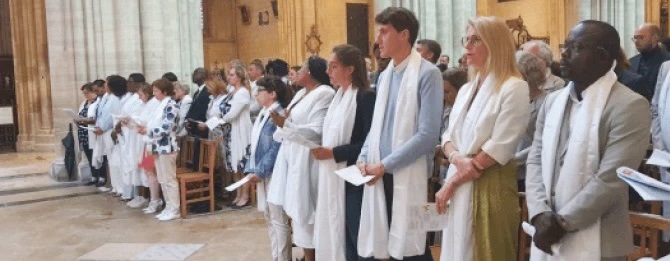
- The growing number of newly baptized people in France [see last month’s RW] are more involved in religious practice and in church after baptism than adult catechumens of 10 years ago. Writing in the British Catholic magazine The Tablet (February 18), Tom Heneghan and Natalie Watson report that a recent survey by the Catholic daily La Croix found that entries in France into propaedeutics, the preparatory year before full seminary studies, increased by 50 percent between 2023 and 2025. Many of the prospective students are part of a wave of adult baptisms in highly secularized France. One view of this phenomenon is that these new Catholics are responding, by asserting their own faith, to the heightened profiles of Muslims and evangelical Protestants in a society that frowns on public displays of religiosity. Propaedeutics enrollment grew from 99 in 2023 to 146 last year. According to one estimate, about 70 percent of these students are expected to enter the seminary, and around half should stay on and be ordained. Heneghan and Watson report that this trend is already prompting seminary directors to consider changes in the way they train young men. Earlier this month, they met in Paris and agreed that rules for entering the seminary needed clarification. Often having grown up without a Catholic background, the newcomers may have some misconceptions about the faith. Fr. Poussier said the newcomers “arrive full of enthusiasm and are ready to give their all for the church. We must be very respectful of their faith journey…[and] careful not to see them just as a pool of new recruits.”
Meanwhile, in Germany, theology departments are experiencing a sharp drop in enrollment. While other arts subjects saw a 12.5 percent decline in the last six years, the numbers of “full-theology” candidates in Catholic faculties in state universities such as Münster, Bonn, and Tübingen fell by more than 50 percent. In church-run institutions the decline is less but still evident; in Frankfurt-St. Georgen, Eichstätt-Ingolstadt and Trier, student enrollment shrunk by about a third. In contrast, the new Cologne University of Catholic Theology reported an increase from 46 to 82 candidates. The five-year degree is the traditional training route for Catholic priests, as well as a requirement for other positions in the church. Faculties of Catholic theology in Germany are provided by the state while the curriculum and teaching staff are approved by the church. The growth in church-run institutions such as Cologne is partly due to rising numbers of international students, as well as missionaries. Heneghan and Watson conclude that the decline poses challenges for future recruitment in the German church, as well as the protected status of such faculties within the church and the state.
(The Tablet, https://www.thetablet.co.uk/news/france-sees-rising-interest-in-seminaries-while-german-theology-numbers-fall/)
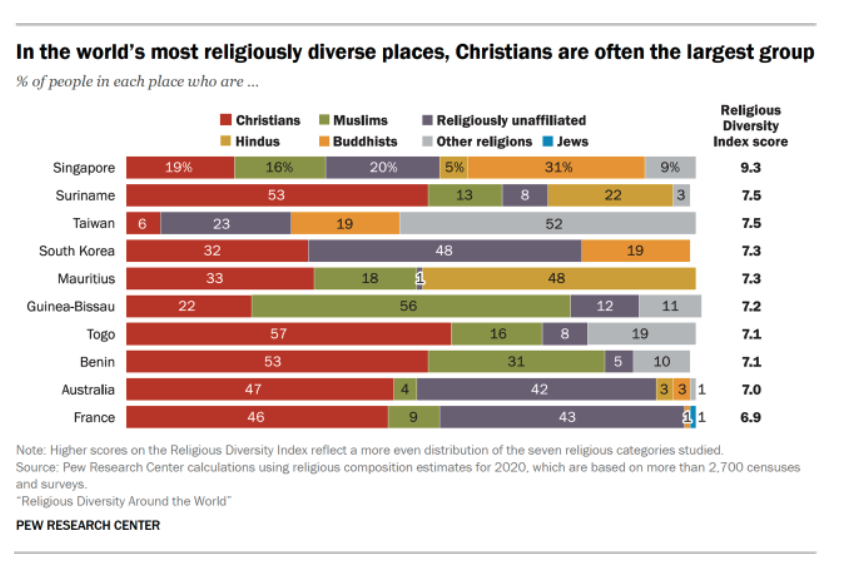
- Singapore has emerged as the world’s most religiously diverse country, according to a new Pew study. The study finds that Buddhists (at 31 percent) are Singapore’s largest religious group, along with substantial shares of religiously unaffiliated people (20 percent), Christians (19 percent), and Muslims (16 percent), plus Hindus (5 percent) and adherents of all other religions (9 percent). In second place for religious diversity is Suriname, the only Latin American country to be in the top 10. Over half of Suriname’s residents (53 percent) are Christians, with the rest mainly Hindus (22 percent), Muslims (13 percent), and religiously unaffiliated people (8 percent). Most of the other countries in the top 10 are in the Asia-Pacific region (Taiwan, South Korea and Australia) or in sub-Saharan Africa (Mauritius, Guinea-Bissau, Togo and Benin). France is the only European country on the top 10 list. Its population is largely Christian (46 percent) and religiously unaffiliated (43 percent), with a sizable Muslim minority (9 percent). Three countries rated the least religiously diverse places in the world: Yemen, Afghanistan, and Somalia.
(The study can be downloaded at: https://www.pewresearch.org/religion/2026/02/12/religious-diversity-around-the-world/)
- During the first four years of the war in Ukraine (from Feb. 24, 2022 to Feb. 24, 2026), at least 742 cases of destruction or damage to religious buildings have been recorded, according to data collected as part of the “Religion on Fire” project of the Workshop of Academic Religious Studies (February 24), a Ukrainian community of religious scholars on Facebook (Orthodoxie.com, March 3). Due to access difficulties, these data only cover the territory under Ukrainian control and do not include the areas occupied by Russia, which represent just under 20 percent of Ukrainian territory. The data is consistent with earlier data reported from other sources by RW [March 2024]. In addition to these figures, a more detailed report is in preparation. Just over half of the destruction (involving 395 sites) affects places of worship belonging to the Ukrainian Orthodox Church. In second place, a quarter of the damage (194 sites) belongs to Protestant communities. In third place is the Orthodox Church of Ukraine (i.e., the autocephalous Ukrainians), with 75 churches affected. Thirty-one Roman Catholic or Greek Catholic churches have also been hit by the war, as well as 22 synagogues. Eleven religious educational institutions have been destroyed or damaged. Finally, there are 18 places of worship of other religions and seven mosques. These are conservative figures, not only because the areas occupied by Russia are not included, but also because some information has probably not yet been obtained. This testifies to “the considerable losses suffered by the country’s religious infrastructure.”
(Facebook page of the Workshop of Academic Religious Studies, in Ukrainian, https://www.facebook.com/officialmarinua)
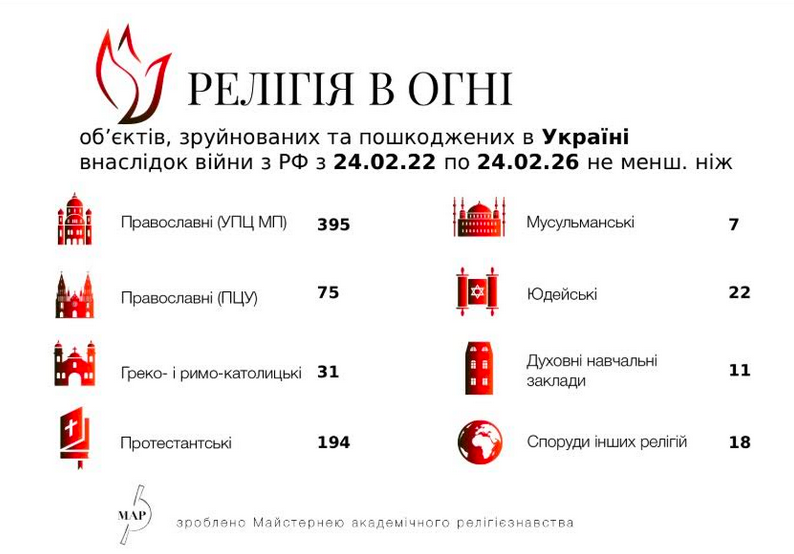
Chart summarizing the statistical data collected by the “Religion on Fire” project.