








Previously presented as an historical phenomenon and an instance of reactionary Islam in textbooks used for religious education in Turkey, Sufi orders (tarikat) are now described in a positive light, writes Manami Ueno (Kyoto University) in Turkish Studies (June). This does not mean that the currently ruling Justice and Development Party (AKP) is willing to […]
Placed under the editorship of the well-known and prolific Italian scholar Massimo Introvigne (Center for Studies on New Religions, CESNUR), Bitter Winter is a new, free online magazine on religious liberty and human rights in China that was launched in mid-May. Its content is available in English, Chinese and Korean. Concerns about the fate of […]
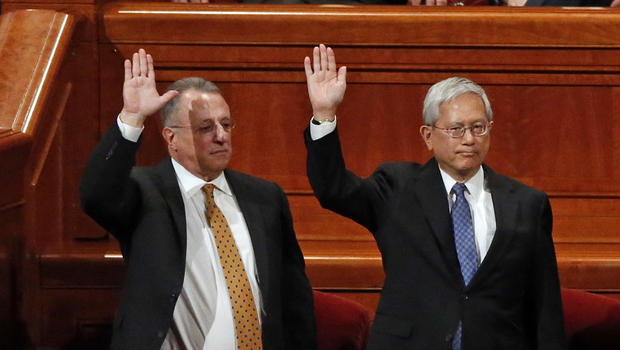
The recent appointment of the Church of Jesus Christ of Latter-day Saints’ newest apostles suggests that the global growth of Mormonism is being expressed at the leadership level. The Conversation magazine (April 9) reports that the two new members of the LDS church’s second-highest governing body, the Quorum of the Twelve Apostles, announced at its recent semiannual General Conference, are a son of Chinese immigrants to the U.S. and a native Brazilian—the first non-white apostles in the church’s history. Matthew Bowman of Henderson State University writes that the selection of Gerrit Gong and Ulisses Soares is an “indication that the church has begun to take seriously the task of growing outside the United States.” The growth of the church in Brazil and the rest of Latin America has been so strong over the past decades that members have expected a Latin American apostle for the last several vacancies. But “while Soares’ selection reflects the Mormon present, Gong’s may point to the future of Mormonism,” Bowman adds. Mormon growth in China is taking place “through expatriates and Chinese citizens converted by Mormon missionaries abroad.” The current president of the LDS church, Russell Nelson, has studied Mandarin and spent a great deal of time in China over his career.
Nelson’s interest in the Chinese church has “been matched by signs that the church as a whole is interested in cultivating a higher profile there. For instance, the church recently launched a website devoted to its relationship with China.” Dallin Oaks, one of the members of the church’s First Presidency, announced that the church has been building “a relationship of trust with Chinese officials”—an effort that may be aided by the appointment of Gong, who has worked at the State Department and Georgetown University. Bowman adds that the globalization of the church could also be seen in moves announced at the conference to decentralize church administration, thereby strengthening local congregations worldwide. In each local congregation, the leadership would be consolidated and simplified. Another change cut the paperwork and bureaucracy surrounding the practices of “home teaching” and “visiting teaching,” where congregants check in with each other monthly to ensure everybody in the congregation is doing well. By loosening its control of this work, the church will be allowing for more local autonomy. It was also announced that seven new temples would be built in such distant locations as India, Russia, and the Phillipines—more signs that the church “sees potential for strong local leadership.”
The new breed of Catholic campus ministry typified by the organization FOCUS has not only shown wide success among students but is influencing parish life with its “spiritual multiplication” approach to growth. A three-part series on FOCUS in the National Catholic Reporter (April 6–19, April 20–May 3) shows how in the last decade, even while […]
Dubbed the “silent exodus” by Helen Lee in 1996, second-generation Korean-Americans are continuing a decades-long trend of leaving their parents’ churches—often to multi-ethnic congregations and, more recently, to non-affiliation. Given that the Christian church has been a shelter where marginalized Korean immigrants, mostly of the first generation, could find comfort in their common cultural identity […]
A recent multigenerational study that spans five decades finds that more than one in five boomers became more religious as they made their way from their 50s to their 60s. The study, conducted by Merril Silverstein and Vern Bengston, used data from 599 respondents in its 2016 wave. Overall, 56 percent of aging boomers said […]
Claiming inspiration from Pope Francis, especially his 2015 Encyclical Laudato si’, Argentinian politicians have been promoting since early 2016 an initiative called “Pacto de San Antonio de Padua” (Pact of Saint Anthony of Padua) that calls for implementation of the guidelines of the Papal Encyclical in government. According to Juan Cruz Esquivel (Consejo Nacional de […]
Despite legal foundations intended to enforce a secular political framework, developments in Brazil over the past ten years have led to a larger presence of religion in the public sphere, reported Marcelo Camurça (Universidad Federal Juiz de Fora) at the April conference on “Politicization of the Sacred and Sacralization of Politics,” which took place at […]
The growth of Protestant festivals and other annual gatherings in France is creating greater unity among members of this religious minority, even if such events often showcase the growing diversity of Protestantism in the country, writes Anne-Laure Zwilling in the Bulletin for the Study of Religion (March). The festivals, often involving concerts, teaching and preaching […]
Secular-leaning newspapers in Algeria have expressed concerns about the expansion of Salafism in the country, reports Anouar Boukhars in Diwan: Middle East Insights from Carnegie (April 18). Due to its predominantly quietist stance and to successful instances of Salafism being a religious exit strategy for previous jihadists, Algerian authorities had often considered the spread of […]