







Congregational membership has dropped by 20 percentage points over the past two decades, hitting a low of 50 percent in 2018, according to a new Gallup poll. Gallup found church membership to be at 70 percent in 1999, consistent with much of the membership rates throughout the 20th century. Since 1999, that figure has fallen […]
The violent persecution of Christians has intensified significantly in the last seven years, with much of this violence shifting to China and India, writes religion journalist Rupert Shortt in the British magazine The Tablet (April 20). Shortt reported on the widespread abuse and repression of Christians in his 2013 book Christianophobia, which, despite its title, […]
Contrary to headlines announcing the loss of Catholic Ireland and an accompanying loss of Catholic education in the country, Catholic schools continue to retain the loyalty of Irish parents, even though these schools are facing new secular pressures from the government. The Irish quarterly Studies (108:429) notes that the Catholic Church has been the main […]
The first Jewish military chaplain in the German armed forces might start his work by the end of this year, reports the German Catholic newspaper Die Tagespost (April 10). This is actually a return to what had existed in earlier times in Germany, since 30 Jewish military chaplains used to serve in the German forces […]
The decision to increase the number and duties of women preachers in Turkey has enlarged the influence and visibility of Islam, especially as it relates to family issues, writes Chiara Maritato in the current issue of the journal Anthropology of the Middle East (Winter). Turkey’s Diyanet, a state-based apparatus under the control of the prime […]
Although President Recep Tayyip Erdogan and his party of nationalism and re-Islamicization remain in place in Turkey after the recent municipal elections, the race revealed the emergence of leaders who are more pragmatic in their approach to both religion and secularism, writes Mustafa Akyol in The Navigator (April 3), the blog of the Center for […]
Halalopathy is a new therapy suggested by Palestinian scientist Jawad Alzeer as a way to give Muslims the extra religious assurances they need about their medical treatments. A researcher at the Institute for Organic Chemistry at the University of Zurich and the lead auditor for a Swiss halal certification body, Alzeer has started publishing articles […]
Faced with space constraints in urban environments such as Singapore, religious groups are responding in flexible ways, writes Orlando Woods (Singapore Management University) in the journal Social Compass (March). Singapore represents an ideal case study for such observations. All religious groups are treated equally by an authoritarian government that has adopted a secular approach for […]
The current issue of the open-access Heidelberg Journal of Religions on the Internet (Vol. 14) is devoted to the impact of online religion on faith communities. There is much conjecture about how online involvement affects religious belonging and community but not much actual research about this relationship in all its variety of settings and contexts. […]
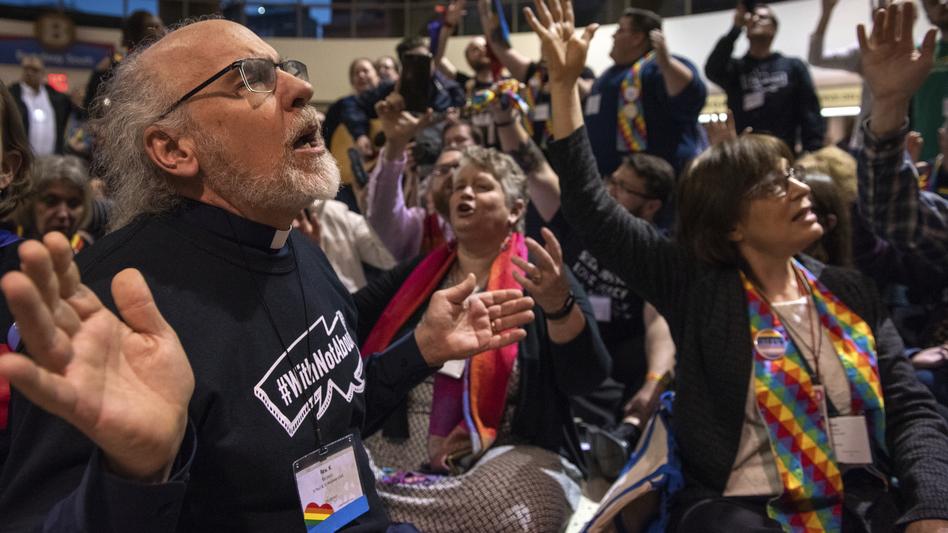
The United Methodist Church’s (UMC) recent decision at a special session of its General Conference in St. Louis to turn down a proposal that would have allowed congregations to ordain gay clergy and ministers to officiate at same-sex marriages is likely to lead to a schism, with liberals either starting their own body or departing for more congenial networks of like-minded mainline churches—it’s just a question of how much of a schism will take place. In the blog Religion in Public (February 26), political scientist Paul Djupe estimates that the United Methodists stand to lose more members and clergy than did the Evangelical Lutheran Church in America (ELCA) in its schism of a decade ago, when conservatives comprising about 10 percent of its membership left the denomination, also over issues of gay rights. Djupe writes that United Methodists may lose double the amount that the ELCA did because the “liberal wing is larger in the UMC than was the conservative side of the ELCA. The liberal wing is also on the side of expanding rights, which is a dominant mode and powerful frame in American political life.” He adds that “churches with younger overall congregations will be more likely to depart. This decision also comes at a time when national ties are frayed as they have not been in a long time, national trust continues at a low point, and people are walking away from traditional ties like never before.”
Djupe speculates that there “is an outside possibility that all of those…United Methodists who are in favor of same sex marriage might depart. That may add up to something more like 40 [percent] of those in favor of same-sex marriage leaving. The total loss in that scenario would reach to something like 2.2 million members lost.” He cites a New York Times report that “pastors and bishops in the United States are already talking about leaving the denomination and possibly creating a new alliance for gay-friendly churches.” Djupe quips that such an organization “already exists, though people more often call it the Episcopal Church. It has some different ways of organizing the denomination and theology, but it’s welcoming even of Lutherans so it’s not far off.”
An article in The Atlantic (February 26) throws some doubt on the prospect of a massive schism, noting that while “the United Methodist Church is often described as a liberal, mainline Protestant denomination, in reality, the body is much more split, even in the United States. In a poll of its American members, the denomination found that 44 percent of respondents described their religious beliefs as traditional or conservative, 28 percent said they are moderate or centrist, and 20 percent identified as progressive or liberal.”