







Crossroads, recently named the fastest growing church in America, has also made a name for itself for its entrepreneurial ministry that is closely integrated with the startup culture of Silicon Valley. The church, based in Cincinnati, was a startup of executives from Procter & Gamble beginning a Bible study in 1990. The church founders used […]
A new study suggests that the recent interest in bringing faith and spirituality to the workplace may be one factor behind rising rates of complaints about religious discrimination on the job. In the Review of Religious Research (March), Christopher Scheitle and Elaine Howard Ecklund note that the rate of reported complaints of workplace discrimination regarding religion has increased from 2.1 percent of all cases of workplace discrimination (1709 incidents) in 1997 to 4.0 percent (3721) in 2013, growing in both number and proportion. The issue of workplace discrimination against religion drew national controversy when the clothing retailer Abercrombie and Fitch was found liable in 2013 after it fired a Muslim employee for refusing to remove her head covering. Past research has found that specific religious identities, such as Muslim, as well as expressing religious identities, can increase the risk of workplace discrimination. But is religion discriminated against apart from specific religious identity and expression? The researchers used a survey of nearly 10,000 U.S. adults that draws on the GfK KnowledePanel, a nationally representative online panel of over 50,000 individuals and one of the few panels to ask a question about religious discrimination in the workplace.
Scheitle and Ecklund find that the frequency with which religion comes up in the workplace is positively associated with perceptions of religious discrimination. Just the presence of religion as a topic of conversation in the workplace “appears to present an independent risk of perceiving religious discrimination…moving from a workplace where religion never comes up to a workplace where religion often does almost triples the probability that an individual will perceive religious discrimination,” they write. The impact of such a dynamic on perceptions of discrimination is greater for mainline Protestants, Catholics, adherents of eastern religions (aside from Islam and Hinduism), those who are not religious, and atheists and agnostics.

Four years after Jorge Bergoglio became Pope Francis, not a few Catholics observers are puzzled by an unusual papacy. In a series of articles in its March issue, the Catholic magazine Inside the Vatican (March/April) has attempted to gather insights on his papacy by a range of contributors. While Inside the Vatican is definitely not […]
Even though evangelical support for Donald Trump did not stop at the voting booth, it may not be the case that such pro-Trump sentiment will drive away members from these churches, writes political scientist Paul Djupe in the blog Religion in Public (April 11). As an example of continuing evangelical support for Trump, Djupe finds […]
Following last year’s visit of Bangladesh’s Prime Minister Sheikh Hasina to Saudi Arabia, the Saudi Kingdom has agreed to finance the building of 560 “model mosques,” evoking mixed feelings among Muslim groups who do not share the Saudi Wahhabi interpretation of Islam. Dhaka Tribune (April 20) reports that these mosques will be equipped with libraries […]
The current issue of the journal Religion and American Culture (Winter, 2017) features a 53-page section on “Studying Religion in the Age of Trump,” bringing together a wide range of prominent scholars to weigh in on this contested topic. Judging by the contributions, the election of Donald Trump has upset the theories and paradigms held […]
St. Matthew’s Catholic Church in Charlotte, North Carolina, is likely the largest parish in the U.S., and much of its growth is intentional and based on the evangelical megachurch model. The parish, with 10,000 registered households, grew from 237 families 30 years ago and mirrors the rapid growth of Charlotte in recent decades. The church […]
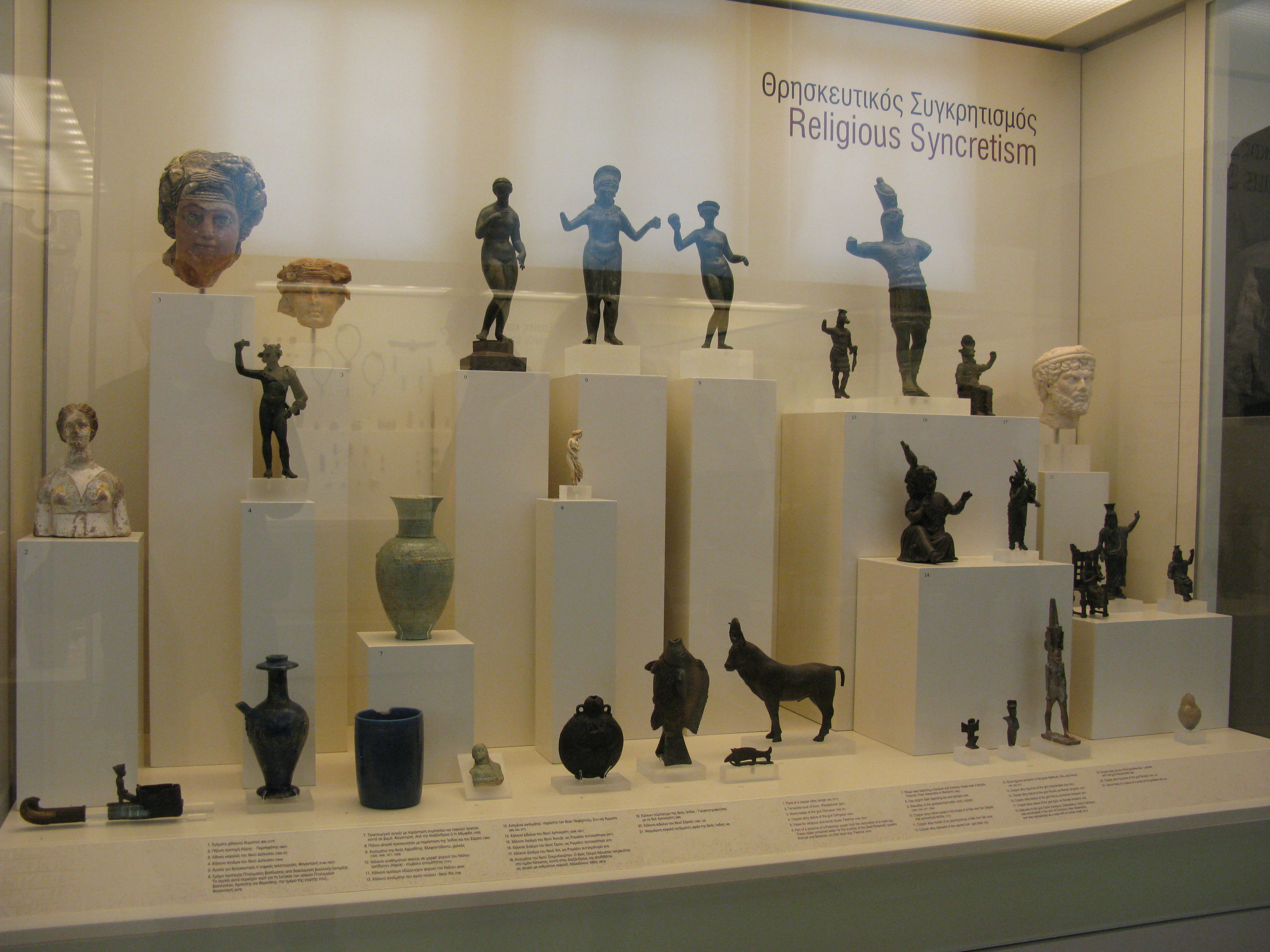
While religious concepts and imagery remains off-limits in many contemporary art galleries, religious artifacts are beginning to find more of a reception in the world’s museums. In the Catholic magazine Commonweal (March 10), Daniel Grant writes, “Sincere expressions of spirituality or religious faith are largely absent from art galleries, except the ones that various churches and synagogues around the United States maintain or the museums of religiously affiliated colleges and universities. Instead, religion appears—when it does appear—as an object of scorn and suspicion.” Grant cites exhibitions at the Virginia Museum of Contemporary Art, which included a painting by Mark Ryden showing a little girl in a Communion dress sawing into a piece of ham that bears the Latin inscription that translates into the “Mystical Body of Christ.” In 2015 the Milwaukee Art Museum acquired the controversial portrait by Niki Johnson of Pope Benedict XVI, “Eggs Benedict,” which was created with 17,000 multi-colored condoms. Grant traces much of the disdain and dismissal of religion to the art school and Master of Fine Arts programs, where students are actively discouraged from creating work that addresses spirituality, ritual, and faith, especially if it concerns Christianity. Art historian and critic James Elkins says that student artists are trained to concentrate on “criticality in relation to existing power structures,” be they received ideas, capitalism, or the church.
While much contemporary art focuses on identity, such as race, gender, and sexual orientation, and religion is one element of identity, those other identity markers are more fluid and open to interpretation, whereas religion is “more set in time and less open to reconsideration, certainly less tolerant of difference,” Grant writes. By the time these artists reach the commercial art world, “they know to keep their beliefs quiet or face rejection.” Grant concludes, “What does seem unnerving is the fear that many art-gallery and museum directors have about offending visitors, even when many of those museum officials bravely defend—on grounds of free expression—artwork that might force parents to cover their young children’s eyes.” The new book Religion in Museums (Bloomsbury, $26.96), edited by Gretchen Buggein, Crispin Paine, and S. Brent Plate, makes a similar critique, though some of the contributors see signs of greater openness to religious themes surrounding art and artifacts. In the Foreword, Sally Promey of Yale University notes that the new interest in religion “roughly coincides with the dismantling of secularization theory,” which had led museums to see religion as a “vestigial organ or appendage, a relic of the past, or a token of presumably less advanced civilizations. …That Sister Corita Kent can be resurrected in 2015–16 as a Pop artist, with art historians paying scant attention, beyond the merely descriptive, to the substance of her religious convictions and practice, however, provides a recent example that demonstrates how tough it is to shake fundamental ingrained cultural hierarchies and biases.”
The election of U.S. President Donald Trump has mobilized the leaders and clergy of mainline and liberal Catholic churches, though it remains to be seen if the members of these churches can be stirred to action to the same extent. Reports indicate that the religious left is being rejuvenated over protests against Trump on such […]
“Rap got religious in 2016. Its beats and bars were baptized by holy lyricism and Gospel samples,” writes Zac Davis in the Jesuit magazine America (March 6). Kanye West started the trend, which is also in evidence among such rap artists as Chance the Rapper and Kendrick Lamar. Davis writes, “For much of the 2000s, […]