








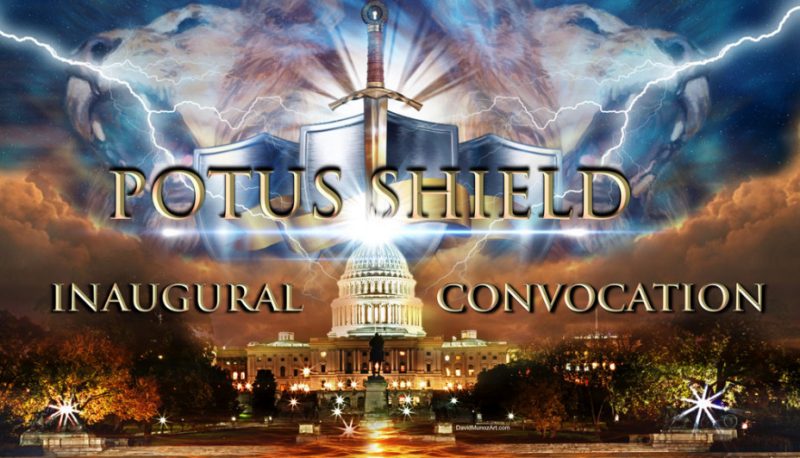
In just a year’s time, media commentators have swung between dismissing the religious right as a spent force and treating it as looming—and often threatening—presence in public life. Judging by recent reports, the religious right today may be a bit of both—weak in an organizational sense but wielding influence through its networks. The website Religion Dispatches (August 4) looks at the group POTUS Shield, a charismatic prayer network based around support for President Trump and his agenda. In an interview with the website, Peter Montgomery, a senior fellow with the liberal People for the American Way, says that leaders such as Rick Joyner and Cindy Jacobs who are connected to the network “aren’t out there trying to create a large organization. They’re not trying to create a Pentecostal Family Research Council. They’re just trying to build up their own networks of followers.” He adds that much of POTUS Shield has its roots in the New Apostolic Reformation, which seeks to reclaim the authority and spiritual gifts of the apostles while creating social transformation.
Montgomery cites the work of sociologists Brad Christerson and Richard Flory, who argue that such loose networks, while flexible enough to allow church leaders to spread their ideas without having any accountability from an organization, may have less political impact since they refrain from the work of organizing for political change. Yet because their networks overlap, with someone like Jerry Boykin of the Family Research Council also serving on the board of POTUS Shield, these groups “help feed people into the kind of political organizing that other religious right groups are doing.” Montgomery portrays POTUS Shield as a new phenomenon, but Charisma magazine (July), which is a strong supporter of Trump and promoter of these networks, links the group to an intercessory prayer movement that has existed for over a decade. The magazine notes that similar groups, such as Justice House of Prayer (JHOP) and Intercessors for America (IFA), are actually experiencing a “second wind.” The groups formed in Washington around 2004 and targeted issues for prayer that ranged from abortion to racial injustice.
The growth of immigrant church leaders seeking to evangelize their fellow immigrants in the U.S., often through transnational groups and congregations, is coinciding with “America’s volatile relationships with immigrants [and] the waning interest of second and third generations who have little memory of their homeland,” reports Christianity Today magazine (July-August). Most of these mission initiatives […]
Holistic health and alternative medicine are finding a following among the far right, even if the ethnic and religious origins of these remedies may seem worlds apart from their agenda, according to Holly Folk of Western Washington University. Folk, who presented a paper at the mid-August meeting of the Association for the Sociology of Religion […]
The use of spirituality and the occult in beauty products is a new feature in the global organic personal care market, which is expected to exceed $25 billion by 2025. The New York Times Style Magazine (August 20) reports that “It is no longer enough to employ pesticide-free ingredients—these days, products should have superpowers, too. […]
Transcendental Meditation (TM) has become highly factionalized since the death of founder Maharishi Mahesh Yogi in 2008, with the familiar scenario of second-generation members chafing under original members seeking to maintain the purity of the movement’s teachings, writes Lane Atmore in the journal Communal Societies (No. 1, 2017). Atmore conducted 44 interviews with TM members […]
The new Baylor Religion Survey finds the emergence of “Trumpism,” a form of Christian influenced nationalism and a widespread fear of religious “others.” The survey, which is the fifth wave of the study and was conducted among 1,501 respondents earlier this year, found that beliefs about God were related to their support of the presidency […]
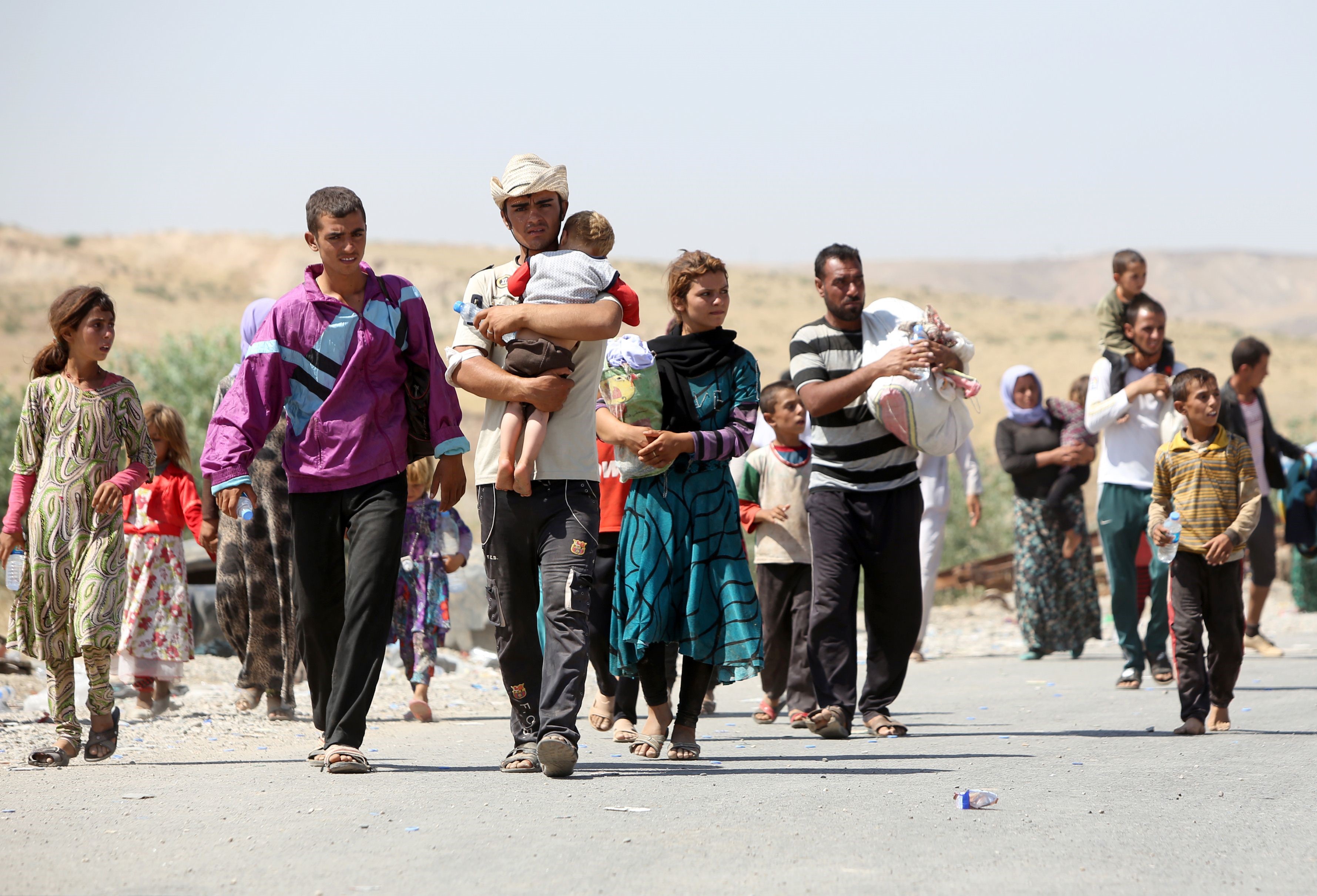
Christians and Yezidis who had suffered deeply under the Islamic State (IS) have celebrated the extremist regime’s recent expulsion from Mosul and the surrounding villages of the Nineveh Plain, with some of these refugees already moving back to their ancestral homeland. But religious and political differences are also returning to the region, with various religious leaders and groups lining up on opposing sides, reports The Tablet (August 12), a Catholic magazine in the UK. Plans about how to resettle these groups have been under debate almost since the IS pushed these religious minorities out of Mosul and the surrounding villages, most notably the proposal to establish an autonomous region for Christians and Yezidis [See June 2016 RW for more on this proposal]. The problem is that Iraqi Kurds, who were instrumental in routing the IS, also dispute claims to the region. The Christians distrust the Kurds, believing that they received little security from Kurdish troops after the Kurds disarmed them.
The Yezidis have fewer issues with the Kurds, but it is the strong political divisions among Christians, who have shrunk from two million to 400,000 today, that make them “easy prey for manipulation,” writes Filipe d’Avillez. Although the crisis in the region has brought the various churches closer together, they still have different takes on politics. The Assyrian Church of the East tends to favor autonomy, as do the Syriac Catholic and Orthodox churches. The leadership of the Chaldean Catholic Church has been more opposed to this idea, though it has recently softened its position. Avillez concludes that an autonomous region may be the only way for these religions to preserve themselves. But for this proposal to work, “church leaders and politicians, the people on the ground and the leaders in the diaspora, will have to achieve something that so far has always proved elusive: to pull in the same direction.”
(The Tablet, http://www.thetablet.co.uk/)
Faced with low oil prices and challenges to its influence, the Saudi Kingdom’s role as the custodian of the holy cities of Mecca and Medina is becoming more important, writes analyst Kamran Bokhari in Geopolitical Futures’ daily digest (Sept. 1). For a long time, the Saudi dynasty was aware of the importance of controlling the […]
Much of the current issue of the journal of Religion, Brain & Behavior (May) is devoted to developing a research program and theory that explains religious diversity just as Darwinian scientists have sought to explain biological diversity. Evolutionary biologists and psychologists have had difficulty in explaining the persistence and diversity of religion. Those anthropologists and […]
1) A movement known as the Remnant is drawing dissident Mormons with its strongly anti-institutional teachings and practices stressing supernatural experiences. Self-proclaimed prophet Denver Snuffer Jr., who claimed to have a face-to-face meeting with Jesus and was excommunicated from the LDS church in 2013, leads the group. Claiming that after the death of founder Joseph […]