Findings & Footnotes
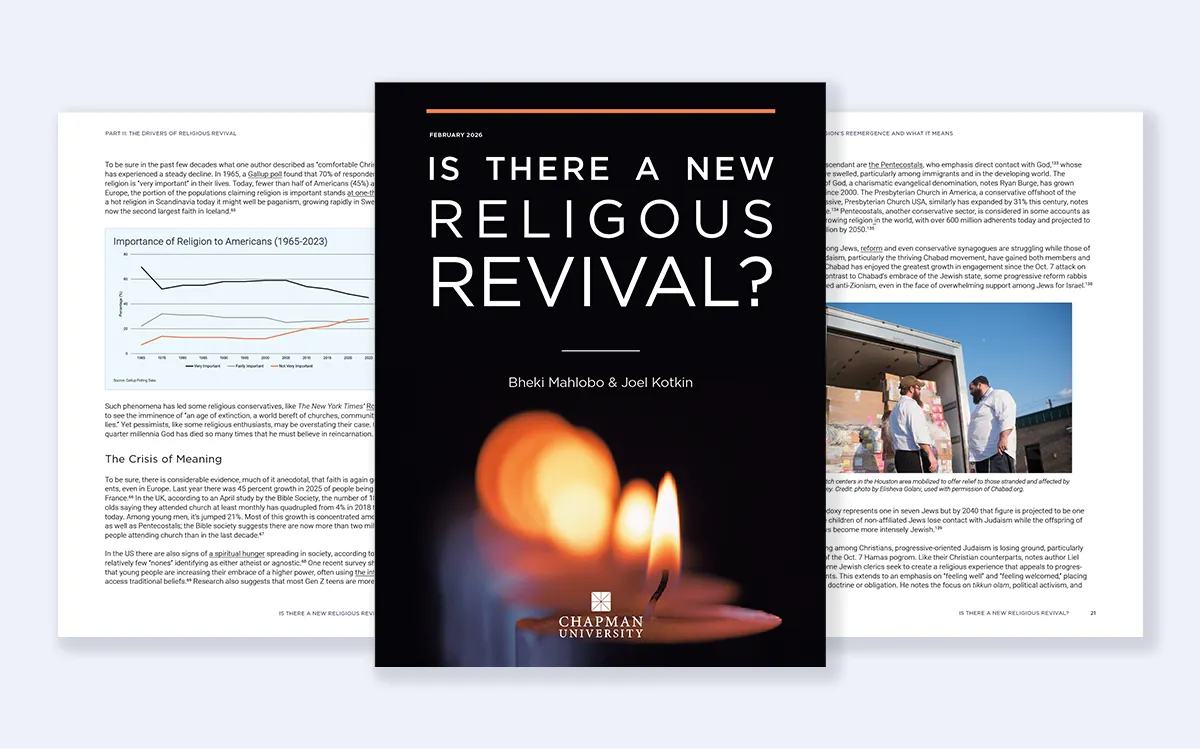
- Scholars, practitioners, and laypeople continue to argue about whether a religious revival is afoot, both in the U.S. and abroad. The new Chapman University-issued report, Is There A New Religious Revival?, by Bheki Mahlobo and Joel Kotkin, probably won’t convince the naysayers, but the 32-page document is unique in bringing together a wide range of quantitative, qualitative, and anecdotal data in making the case for at least a quasi-religious or a “post-secular” resurgence. The authors acknowledge that, in much of the West at least, the indicators are more often pointing in the other direction, such as the widespread rates of non-affiliation among young adults. But they show that even this pattern is showing some signs of reversal, citing examples of young men returning and converting to religious groups ranging from the Orthodox and Hasidic Chabad movement to conservative Catholic, Protestant and Eastern Orthodox churches. Mahlobo and Kotkin place some credence in the “quiet revival” in the UK, even as critics have faulted surveys of this phenomenon for lacking true random samples. But the report is on more solid footing in its citing of shifts in the discourse of intellectuals toward religion and spirituality and away from the new atheism; the fact that religious affiliation has “evolved into a form of elite social behavior linked to stability, community leadership, and bourgeois respectability”; the ways in which religions are functioning as a form of “social insurance,” substituting for government welfare, particularly for weak states; and “the growing evidence of religion’s utility, including its provision of [a] spiritual anchor, [which] seems likely to grow by offering a viable alternative to [the] hyper-competitiveness and individualism rife in secular-driven societies.” To download this report, visit: https://blogs.chapman.edu/wp-content/uploads/sites/56/2026/02/Is-There-a-New-Religious-Revival_Report-2026.pdf?