








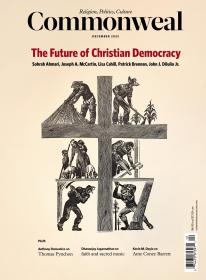
The December issue of Commonweal magazine features a symposium on the future of Christian democracy based around the opening essay of conservative Catholic writer Sohrab Ahmari. Democracy is increasingly being called into question by prominent Christian intellectuals, political activists, and even some politicians, while “some progressives doubt that traditional Christian beliefs are compatible with liberal democracy,” according to the editors. By “Christian democracy,” Ahmari most often means the political and economic policies and parties promoting Catholic social teachings that were inaugurated by Pope Leo XIII in the late 19th century (and that Pope Leo XIV is attempting to revive today). Christian Democratic parties and ideas steered a middle ground between Marxism and laissez-faire capitalism, calling for the economic rights of workers, family, and associational life, while working against the class antagonism inherent in Marxism.
Ahmari writes that this Catholic social tradition has been challenged by neoliberalism and, more recently, by technological innovation, especially AI, and the way it might threaten the rights of workers and diminish human creativity, for all the good it might also accomplish. The respondents to Ahmari’s article praise the way the conservative thinker may be building bridges with the political left, especially on the emerging AI challenges, while seeking to revive Catholic social teachings. Yet they criticize his silence on other issues related to Catholic social teaching, such as ministry and support for immigrants and how Catholic institutions themselves have shown little support for organizing unions and fair treatment of its workers. Political scientist John Dilulio responds that Ahmari’s warnings are, if anything, too late about AI’s negative repercussions—from draining electricity and water supplies through its data centers to “making us not just clever creatures but pseudocreators; and perverting, corrupting, and capturing hearts and minds that long to be the Creator, one that can dial up digital immortality for others and plan to ‘resurrect’ oneself.” To download this symposium, visit: https://www.commonwealmagazine.org/future-christian-democracy
The journal of Pentecostal studies Pneuma devotes a double issue (3–4) to trends and new research in African Pentecostalism. While the journal has covered many topics involving African Pentecostal churches in recent years, the current issue draws on a wide range of recent research to look at the state of the faith on the continent. The introduction notes that 23 percent of Christians in Africa are Pentecostal, likely a low number due to the inroads Pentecostalism has made in other churches. An article by Mookgo Solomon Kgatle discusses how Pentecostalism has grown in Africa by relating to the lived religious experiences of Africans in a way that other faiths have not. An interesting aspect of this is the way Pentecostal churches have made “giving testimonies”—members’ accounts of how they came to the faith and experienced miracles—a central part of their services and are now extending these testimonies through social media and other productions throughout Africa. Kgatle provides an overview of the many kinds of Pentecostal churches in Africa—such as new prophetic churches, classical Pentecostals with roots in the U.S. and Canada, the Word of Faith movement, and African Independent Churches.
Kgatle also looks at such trends as the way the prosperity movement has moved beyond its origins in the U.S. to focus more on the prosperity and development of the community rather than just the pastor and congregation. This is tied to the way that Pentecostalism has gradually embraced a holistic faith that embraces politics and economics, seen especially in Ghana and Nigeria. The way that Pentecostalism addresses the lived religion of Africans is nowhere clearer than in its strong emphasis on spiritual warfare, deliverance and healing, which provides answers for many venerating and warding off the influence of perceived spirits. Among the most impactful trends is the reverse migration to the West of African Pentecostals, many of whom have had notable success in reaching out to non-Africans once there. Kgatle notes that there have been notable failures among these migrant churches in reaching indigenous populations, such as with the Apostolic Faith Mission International Ministry. Yet he argues that “African migrant churches are better placed in reviving Christian spiritualities in the West through their pneumatic approaches to prayer, church fellowship, and spiritual services.” Other articles cover the growing ecological involvement of African Pentecostal churches and the way Nigerian Pentecostals have blended associations with cats with witchcraft accusations in the Yoruba spiritual imaginary. For more information on this special issue, visit: https://brill.com/view/journals/pneu/47/3-4/pneu.47.issue-3-4.xml

While the goal of evangelizing unreached people groups has been a key concern of Western evangelical missionaries since the 1970s, it is being challenged both by missionaries and Christians in the global South. The November/December issue of Christianity Today features a roundtable of mission leaders on how they are rethinking the concept. The original idea of “unreached people” was defined as an ethnolinguistic group in which evangelicals comprise 2 percent of the population. The term was used by mission mobilizers and missionaries to urge on evangelical Christians to contribute and participate in global missions. Samuel Law, a missions professor in Singapore, argues that the idea of unreached people groups downplayed the role of indigenous Christians in spreading the faith. Today it is local churches evangelizing neighboring tribes rather than mission agencies. He adds that the location of the “unreached” has changed, with few countries not having an evangelical presence. In another article, Chris Howles, a cross-cultural mission mobilizer, writes that cities in the world today are where cultures mingle and evangelism has become more of a lifestyle. The same is true for technology, where evangelical content is available to the masses through their phones and social media. In situations where language barriers persist, the rapid development of AI translation tools making for communication across linguistic divides may soon be a reality for outreach. This roundtable issue is available from: https://www.christianitytoday.com/2025/11/unreached-people-groups-missions-missionary-global-evangelism-bible/